
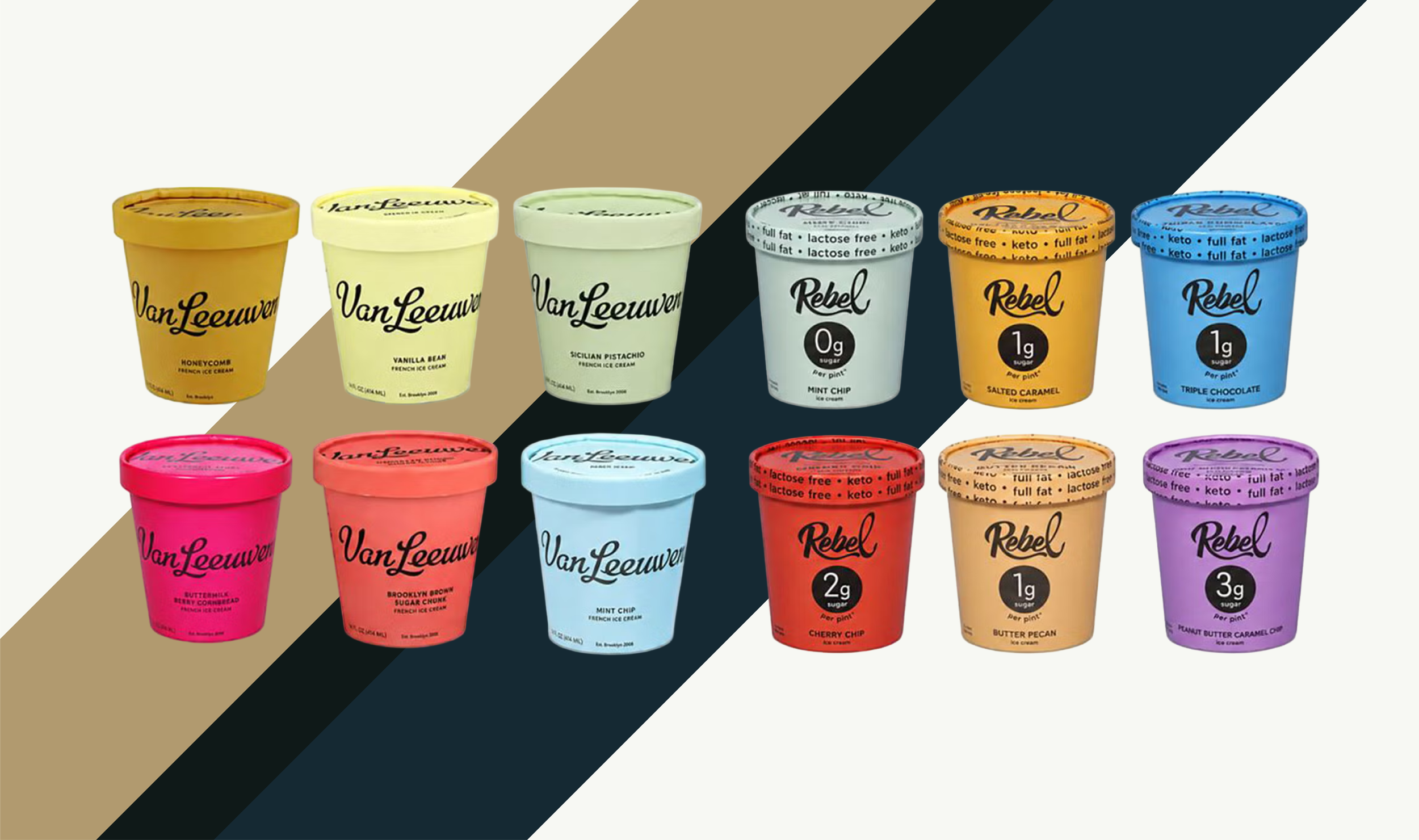
A recent federal court decision involving two ice cream brands offers a significant reminder that trademark protection can extend well beyond a company’s name and logo—and that the overall appearance of product packaging can become a valuable, enforceable intellectual property asset.
In July 2026, the U.S. District Court for the Eastern District of New York entered judgment in favor of Van Leeuwen Ice Cream LLC in its long-running trade dress dispute with Utah-based Rebel Creamery LLC. Following a bench trial, U.S. District Judge Eric R. Komitee found Rebel liable for trade dress infringement under the Lanham Act, as well as trade dress infringement, unfair competition, and dilution under New York law.
The result was substantial. The court ordered Rebel to redesign its packaging and awarded Van Leeuwen $23.785 million in Rebel’s profits attributable to sales of the infringing ice cream pints.
The case, Van Leeuwen Ice Cream LLC v. Rebel Creamery LLC, No. 21-CV-2356 (E.D.N.Y.), provides an important illustration of how trade dress law can protect the visual identity of consumer products—even when competitors use entirely different brand names.
A Dispute About the Package, Not the Name
Van Leeuwen began in Brooklyn in 2008 and eventually developed a distinctive visual identity for its ice cream pints. Its packaging featured a minimalist aesthetic built around monochromatic cardboard containers and matching lids, pastel colors, prominent black script lettering, and relatively restrained descriptive text.
Rebel Creamery entered the market years later with a line of low-carbohydrate, keto-oriented ice cream.
The companies' names were plainly different. Van Leeuwen's lawsuit, however, was not principally about Rebel using a similar name. Instead, Van Leeuwen alleged that Rebel adopted packaging that created a confusingly similar overall commercial impression.
Van Leeuwen identified its trade dress as a combination of several features, including:
monochromatic cardboard pints with matching monochromatic lids;
a primarily pastel color palette or pastel-tinted hues;
black script lettering featuring an exaggerated capital letter, together with additional descriptive black lettering; and
an overall minimalist design aesthetic.
That distinction is important. Trade dress law can protect the overall appearance or presentation of a product or its packaging when that appearance functions as an indicator of source.
A competitor therefore does not necessarily avoid trademark liability simply by using a different company name or logo.
The Combination of Ordinary Elements Can Be Protectable
One of the more significant aspects of the court's decision concerns the way trade dress is analyzed.
Rebel argued, among other things, that individual elements of Van Leeuwen's packaging—such as pastel colors, script fonts, and minimalist packaging—were common within the food industry.
But trade dress generally is not evaluated by dissecting a design into individual components and asking whether each component, standing alone, is protectable. The relevant inquiry can instead focus on the overall combination of elements and the commercial impression they create.
That principle has potentially broad implications for consumer brands.
A company may not have exclusive rights to pastel colors. It may not have exclusive rights to black script lettering. And it may not have exclusive rights to minimalist packaging. But a sufficiently distinctive combination of otherwise commonplace elements may nevertheless function as source-identifying trade dress.
For businesses developing consumer-facing products, that makes the overall visual system surrounding a product potentially as important as any individual logo or word mark.
Evidence of Intentional Copying Proved Particularly Damaging
The court's findings concerning Rebel's intent were especially consequential.
Following trial, Judge Komitee concluded that Rebel had intentionally copied Van Leeuwen's trade dress. The court examined not merely the similarities between the finished packages but evidence concerning how Rebel's packaging was developed and what Rebel knew about Van Leeuwen's products.
The court ultimately rejected Rebel's contention that its similar packaging had been independently developed and found that Rebel acted in bad faith.
Intent is not the only consideration in determining trademark infringement. The central infringement question remains whether the challenged use is likely to cause consumer confusion. But evidence suggesting deliberate copying can significantly affect the litigation.
Here, the court found evidence of actual consumer and industry confusion in addition to the similarities between the competing packaging.
The combination proved costly.
A $23.785 Million Remedy
Perhaps the most striking aspect of the decision is the remedy.
Van Leeuwen sought an accounting of Rebel's profits under the Lanham Act. The court ultimately awarded $23,785,000, representing a substantial portion of Rebel's profits from sales of the infringing products.
The court also entered a permanent injunction prohibiting Rebel from selling products bearing trade dress likely to be confused with Van Leeuwen's and requiring Rebel to redesign its packaging to create a substantially different commercial impression.
The decision demonstrates why intellectual property disputes can involve stakes far beyond the cost of changing a label.
Under the Lanham Act, available remedies can include injunctive relief and, in appropriate circumstances, recovery of a defendant's profits. A company that builds a successful product around packaging later determined to infringe another company's trade dress may therefore face both the expense and disruption of a redesign and substantial monetary exposure tied to years of sales.
Rebel Appeals—and Files Chapter 11
The district court's decision may not be the final word.
Rebel filed an appeal with the U.S. Court of Appeals for the Second Circuit in August 2026. Shortly thereafter, Rebel filed for Chapter 11 bankruptcy protection in the U.S. Bankruptcy Court for the District of Utah.
As a result, the litigation now presents issues extending beyond trademark law into appellate and bankruptcy proceedings. The appeal provides Rebel an opportunity to challenge the district court's findings and judgment, while the Chapter 11 proceeding affects Van Leeuwen's ability to immediately enforce and collect the monetary judgment.
The underlying district court decision nevertheless remains an important example of the potentially substantial value—and risk—associated with product trade dress.
The Broader Lesson for Brand Owners
The Van Leeuwen decision highlights an aspect of trademark strategy that businesses sometimes overlook: a company's protectable brand may be considerably larger than its registered name and logo.
Product packaging, color combinations, typography, layouts, labeling conventions, product configuration, retail presentation, and other visual elements can collectively develop source-identifying significance.
Businesses should therefore consider trade dress at both ends of the product-development process.
When developing a distinctive packaging system, companies should consider whether that appearance is becoming a recognizable brand asset and how evidence of its development, use, advertising, and consumer recognition can be preserved.
Conversely, companies introducing new packaging should evaluate more than whether their proposed name or logo clears a conventional trademark search. A materially different word mark does not necessarily eliminate infringement risk if the overall appearance of the product is sufficiently similar to a competitor's protectable trade dress.
The case also underscores the importance of documenting the independent development of branding and packaging. Design files, drafts, communications with designers, creative briefs, market research, and records showing the evolution of a design may become important evidence if the originality of a company's packaging is later challenged.
Trade Dress as a Business Asset
For sophisticated brand owners, the larger takeaway is that trademark strategy should extend beyond registration.
A company's visual identity can accumulate substantial goodwill even when individual components of that identity would not independently qualify for exclusive protection. Identifying those assets early, developing them consistently, and incorporating them into a broader intellectual property strategy can materially strengthen a company's competitive position.
The dispute between Van Leeuwen and Rebel Creamery is an unusually vivid example. What began as similarities between ice cream containers ultimately resulted in a federal injunction, a required packaging redesign, and a judgment approaching $24 million.
For businesses investing heavily in the development of consumer brands, the message is straightforward: the package itself may be one of the most valuable trademarks the company owns.