
Estate Planning for Real Estate Families

Preserving a Multigenerational Real Estate Portfolio
Introduction
For families that have accumulated substantial wealth through real estate, estate planning presents challenges that are fundamentally different from those facing families whose wealth consists primarily of marketable securities.
A successful real estate family may own apartment communities, commercial buildings, development land, industrial properties, agricultural ground, or interests in numerous real estate ventures. Those assets may be held through a network of limited liability companies and partnerships, subject to substantial debt, managed by different members of the family, and characterized by widely varying tax bases and cash flows.
The result is an estate that may be extremely valuable on paper while remaining relatively illiquid.
For these families, effective estate planning requires much more than preparing a will and revocable trust. It requires coordinating estate and gift tax planning, entity structuring, income-tax planning, asset protection, liquidity, real estate operations, and family governance.
The objective is not simply to transfer property to the next generation. It is to transfer a functioning real estate enterprise.
Done correctly, an estate plan can allow a family to preserve control of its portfolio, transfer future appreciation outside the taxable estate, protect assets from unnecessary fragmentation, create liquidity for taxes and other obligations, and establish a governance structure capable of surviving the transition from one generation to the next.
This paper examines several of the most important strategies available to real estate families and the considerations that should guide their implementation.
I. Real Estate Wealth Requires Different Planning
Real estate creates several characteristics that make conventional estate planning more difficult.
Illiquidity
A family may have a net worth of $40 million, $100 million, or more without holding a corresponding amount of cash or marketable securities.
Much of the family's wealth may instead be represented by equity in buildings, development projects, or land.
That distinction becomes critical when an estate must satisfy taxes, debts, equalization payments, or other obligations. A poorly structured estate plan can force the sale or refinancing of assets at precisely the wrong time.
Concentrated Appreciation
Successful real estate investments can appreciate substantially over decades. Development property can experience even more dramatic increases in value when land is entitled, developed, leased, or repositioned.
That appreciation creates both an opportunity and a problem.
From an estate-tax perspective, transferring an asset before substantial appreciation occurs can move that future appreciation outside the transferor's taxable estate.
From an income-tax perspective, however, retaining appreciated property until death may provide a significant advantage because property acquired from a decedent generally receives a basis determined by its fair market value at death under Internal Revenue Code § 1014.
The sophisticated real estate estate plan therefore does not simply ask:
How much property can we remove from the estate?
It also asks:
Which property should we remove?
Those questions can produce very different answers.
Leverage
Real estate portfolios frequently contain substantial debt.
Debt affects valuation, cash flow, income-tax consequences, refinancing flexibility, partnership tax allocations, and the economics of transferring interests between generations.
The estate plan therefore must be coordinated with the family's financing structure rather than developed independently from it.
Active Management
Unlike a diversified investment account, a real estate portfolio may depend heavily upon the knowledge and relationships of one or two family members.
Someone must negotiate leases, approve capital expenditures, supervise property managers, interact with lenders, evaluate acquisitions, manage development projects, and decide when assets should be sold or refinanced.
Transferring economic ownership without addressing managerial control can therefore create significant problems.
Multiple Family Members With Different Objectives
The second generation may include one child who works full time in the family business, another who has a separate career, and another who simply wants investment income.
Equal ownership does not necessarily produce equitable results.
One of the central purposes of advanced planning should therefore be to distinguish between economic ownership and managerial control.
II. The 2026 Transfer-Tax Environment
Federal transfer-tax law provides significant planning capacity for wealthy families.
For 2026, the federal basic estate and gift tax exclusion is $15 million per individual, and the federal generation-skipping transfer tax exemption is likewise $15 million. The annual gift-tax exclusion is $19,000 per recipient for 2026.
For a married couple, proper planning can therefore provide substantial federal transfer-tax capacity.
But exemption alone should not determine the estate-planning strategy.
Consider a family that owns $30 million of real estate today. If those assets compound in value over the next twenty years, the eventual estate may bear little resemblance to the family's current balance sheet.
For that family, the critical planning opportunity may be the ability to transfer future appreciation rather than simply current wealth.
That concept lies at the center of many advanced estate-planning strategies.
III. Building the Family Real Estate Holding Structure
Before implementing sophisticated trusts or transfer-tax strategies, many real estate families should first examine how their assets are owned.
A portfolio accumulated over decades frequently develops organically.
One property may be owned individually. Another may be owned through an LLC. Several properties may be owned with unrelated partners. Management employees may hold interests in particular projects. Other entities may own development land, operating businesses, equipment, or management companies.
Estate planning provides an opportunity to rationalize that structure.
A. Property-Level Entities
Individual properties are commonly held through separate limited liability companies or similar entities.
Among other considerations, this can provide liability segregation and facilitate financing, management, accounting, and eventual disposition.
Instead of transferring fractional interests in the underlying real property itself, a family can potentially transfer interests in the entity that owns the property.
B. Family Holding Companies
For some families, an additional family holding company or partnership may sit above multiple property-level entities.
A simplified structure might look like this:
Family Holding LLC
→ Apartment LLC
→ Office Building LLC
→ Industrial LLC
→ Development LLC
→ Land LLC
→ Management Company
The appropriate structure depends heavily upon tax, financing, liability, and operational considerations, and consolidation is not appropriate in every situation.
When properly designed, however, a family holding structure can provide an important platform for succession planning.
C. Voting and Nonvoting Interests
One particularly useful strategy is separating control from economics.
The senior generation might retain voting or managerial interests while transferring nonvoting economic interests to children or trusts for descendants.
This can allow parents to begin transferring wealth without immediately surrendering operational control over the portfolio.
The distinction is especially important when only certain members of the next generation are involved in the family business.
Ownership does not have to mean management.
IV. Transferring Interests During Life
Once an appropriate entity structure is established, a family can evaluate whether lifetime transfers make sense.
The central economic principle is straightforward:
When an asset is expected to appreciate substantially, transferring it earlier can potentially transfer that future appreciation outside the transferor's taxable estate.
Suppose a family transfers an interest worth $5 million today and that interest is worth $15 million twenty years later.
Subject to the particular structure and applicable tax rules, the planning benefit may extend well beyond the original $5 million transfer. The additional $10 million of appreciation may occur outside the transferor's estate.
For real estate families, this can make assets with substantial development or appreciation potential particularly interesting candidates for lifetime planning.
Examples may include:
development land before entitlement;
interests in projects before stabilization;
properties undergoing repositioning;
interests in growing real estate operating companies; and
long-term assets located in rapidly appreciating markets.
Timing, however, must be evaluated carefully. Transactions occurring shortly before a known sale, recapitalization, or other liquidity event can present additional tax issues and require particular scrutiny.
V. Family LLCs, Partnerships, and Valuation
Real estate families often use limited liability companies or family partnerships not merely as tax-planning vehicles, but as genuine business organizations.
A properly structured entity can establish rules concerning:
management authority;
voting rights;
distributions;
capital calls;
transfers;
rights of first refusal;
admission of new owners;
creditor protection;
dispute resolution; and
succession of management.
These provisions can be as important as the tax planning itself.
Valuation Considerations
An interest in a closely held entity is not necessarily worth its mathematical percentage of the entity's underlying assets.
Depending upon the facts, restrictions on control and marketability may affect fair market value.
For example, a minority owner who cannot compel distributions, sell underlying property, direct management, or readily sell the ownership interest may hold an asset economically different from a proportionate share of the underlying real estate.
Any valuation position should be supported by a qualified independent appraisal and must reflect the actual legal and economic characteristics of the transferred interest.
Just as importantly, entity planning should have genuine business and family purposes beyond tax reduction.
Families should be particularly cautious about transferring assets to an entity while informally continuing to treat those assets as if nothing changed. Internal Revenue Code § 2036 can cause transferred property to be included in a decedent's gross estate when the transferor retains certain rights to income, possession, enjoyment, or control. IRS Form 706 instructions specifically address retained interests under § 2036.
The formalities matter.
So does the underlying economic reality.
VI. Using Trusts to Preserve Family Wealth
Direct gifts to children are often not the optimal method of transferring substantial real estate wealth.
Instead, families frequently use long-term irrevocable trusts.
A trust can potentially protect inherited wealth from a beneficiary's creditors, divorce, financial immaturity, or poor investment decisions while allowing the property to remain available for the beneficiary's benefit.
Properly structured trusts can also separate economic benefit from investment and managerial authority.
For example, a child may be a beneficiary of a trust that owns an interest in the family real estate company without possessing unilateral authority to sell the underlying properties.
That distinction can be extremely important to multigenerational planning.
Dynasty and Generation-Skipping Trusts
For families seeking to preserve wealth beyond the children's generation, generation-skipping planning becomes particularly important.
In 2026, the federal GST exemption is $15 million per individual.
When GST exemption is properly allocated to a long-term trust, the structure can potentially allow property and its subsequent appreciation to benefit multiple generations without being subjected to transfer tax at every generational level, subject to applicable law and proper administration.
For a real estate family contemplating ownership over generations rather than years, this can fundamentally change the planning horizon.
VII. Spousal Lifetime Access Trusts
A Spousal Lifetime Access Trust, commonly called a SLAT, can be particularly useful for married couples.
In a typical structure, one spouse transfers assets to an irrevocable trust established for the benefit of the other spouse and potentially descendants.
If properly structured, the transferred assets and subsequent appreciation may be outside the grantor's taxable estate, while the beneficiary spouse retains potential access to trust distributions.
For real estate families, the transferred property may consist of interests in the family holding company rather than individual parcels of real estate.
That can allow a family to move substantial economic value into a trust without disrupting property-level operations.
SLATs nevertheless require careful planning. Death or divorce can eliminate the grantor spouse's indirect access to trust assets, and couples establishing trusts for each other must consider the reciprocal trust doctrine.
The goal should not be to create two mirror-image trusts that effectively leave both spouses in the same economic position they occupied before the transactions.
VIII. Sales to Grantor Trusts
Another powerful technique for appreciating real estate interests involves selling assets to an irrevocable grantor trust in exchange for a promissory note.
Conceptually, the transaction separates today's value from tomorrow's appreciation.
Assume a real estate owner sells an interest worth $10 million to an appropriately structured trust in exchange for a $10 million note.
The trust must satisfy the note according to its terms. But if the transferred property appreciates at a rate exceeding the economic cost of the note, the excess appreciation can potentially accumulate for the trust beneficiaries rather than in the seller's estate.
This strategy can be particularly attractive for real estate because the transferred interests may generate cash flow that can help service the note.
Grantor-trust status adds another potentially significant feature. Under the grantor-trust rules, trust income may be taxable to the grantor rather than the trust. The IRS describes a grantor trust generally as one in which specified powers or ownership benefits cause the income and deductions of the trust to be treated as belonging to the grantor.
As a result, the grantor's payment of income tax can allow trust assets to continue compounding without being depleted by those taxes, subject to the terms and structure of the particular trust.
Sales to grantor trusts are sophisticated transactions. Valuation, adequate capitalization, note terms, interest rates, trust design, cash flow, and transaction documentation all require careful attention.
IX. GRATs and Real Estate Appreciation
A Grantor Retained Annuity Trust, or GRAT, provides another mechanism for transferring appreciation.
The grantor transfers property to an irrevocable trust while retaining the right to receive an annuity for a specified period. GRATs are specifically recognized under Internal Revenue Code § 2702.
At the end of the GRAT term, remaining property passes to the designated beneficiaries or continuing trusts.
The strategy is generally most successful when the transferred assets appreciate at a rate greater than the assumed rate used in valuing the retained annuity.
Real estate interests with substantial appreciation potential may therefore be candidates for GRAT planning.
For example, a family might consider transferring an interest in a development company or real estate entity before a significant period of anticipated growth.
GRATs carry an important mortality risk. If the grantor dies during the applicable term, some or all of the trust property may be included in the grantor's gross estate under § 2036. IRS guidance specifically addresses the estate-tax treatment of retained annuity interests.
X. The Basis Problem: Sometimes the Best Estate Plan Is Not to Gift the Property
Perhaps the most overlooked issue in sophisticated estate planning is the tension between estate-tax savings and income-tax basis.
Real estate families should not automatically attempt to remove every valuable asset from the taxable estate.
Under Internal Revenue Code § 1014, property acquired from a decedent generally receives a basis equal to its fair market value at death, subject to statutory exceptions.
That adjustment can be enormously valuable for real estate that has been owned for decades.
Consider a property:
Original tax basis: $2 million
Current value: $12 million
If the owner gives the property away during life, the recipient generally does not receive the same basis adjustment that would ordinarily apply to property acquired at death.
If instead the property remains includible in the owner's estate and qualifies for § 1014 treatment, the basis may be adjusted to its applicable estate-tax value.
The difference can materially affect the income-tax consequences of a later sale.
That means the appropriate strategy is not simply:
Reduce the taxable estate as much as possible.
It may instead be:
Minimize the family's combined estate, gift, income, and capital-gains tax burden.
For some families, highly appreciated, low-basis assets may be attractive assets to retain in the taxable estate, while higher-basis assets with substantial future appreciation potential may be better candidates for lifetime transfer.
This analysis should be revisited periodically because property values, basis, debt, tax laws, and family circumstances change.
XI. Basis Swaps and Grantor Trust Planning
Sophisticated grantor trusts can create additional planning opportunities when the trust instrument and applicable law permit substitution of assets.
Consider a grantor who previously transferred a low-basis real estate interest to an irrevocable grantor trust.
Years later, that property has appreciated substantially.
If permitted by the governing documents and applicable tax rules, the grantor may be able to substitute cash or other assets of equivalent value for the low-basis property held by the trust.
The low-basis asset can thereby return to the grantor's estate while other assets remain in trust.
If the grantor later dies holding the real estate and the property qualifies for basis adjustment under § 1014, the strategy may potentially combine earlier estate-tax planning with later basis planning.
This illustrates an important principle:
Advanced estate planning should be managed over time rather than implemented once and forgotten.
The optimal assets to hold inside or outside a taxable estate may change dramatically during a family's lifetime.
XII. Planning for Debt
Leverage makes real estate estate planning more complicated.
Before transferring interests, advisers should understand:
property-level mortgage debt;
personal guarantees;
partnership liabilities;
refinancing restrictions;
lender consent requirements;
debt allocations among partners;
capital accounts;
potential income-tax consequences of shifting liabilities; and
whether projected cash flow can support notes, annuities, distributions, and capital calls.
A transfer that appears attractive from an estate-tax perspective may be problematic if it violates loan covenants or materially changes the owner's tax position.
Estate counsel should therefore coordinate significant transfers with the family's CPA, valuation professional, financial advisers, and—where appropriate—lenders.
XIII. Liquidity Planning
One of the greatest risks facing a wealthy real estate family is being asset rich and cash poor when liquidity is most needed.
Death can create demands for cash arising from taxes, debt obligations, administration expenses, family equalization, operating expenses, and other obligations.
Without advance planning, the estate may have to:
sell a property;
refinance;
distribute assets unequally;
borrow under unfavorable circumstances; or
bring outside investors into the portfolio.
Each can interfere with the family's long-term investment strategy.
Life Insurance
Life insurance can provide a source of liquidity that is not dependent upon selling real estate.
For appropriate families, an irrevocable life insurance trust may own insurance intended to provide liquidity outside the insured's taxable estate, subject to the applicable ownership and transfer rules.
Insurance can also be useful when the family intends to leave the real estate business to one child while providing other assets to children who are not involved in the enterprise.
The objective is not necessarily to divide every asset equally.
It is to create an economically sensible allocation without destroying the underlying business.
XIV. Equal Is Not Always Equitable
Suppose parents have three children.
One child has spent fifteen years working in the family real estate company. The other two have successful careers elsewhere.
Leaving each child one-third of every entity may initially appear fair.
Operationally, it can be disastrous.
The active child may believe that years of work entitle him or her to greater control. The inactive children may expect regular distributions. The active child may want to reinvest cash flow into acquisitions while the others prefer distributions. Eventually, fundamental decisions concerning refinancing, development, capital expenditures, and sales can become family disputes.
A better plan may distinguish among: management, voting control, economic ownership, and inheritance.
The child operating the business might receive or control voting interests while all three children participate economically.
Alternatively, trusts can hold interests for family members while a manager, board, or investment committee exercises defined authority.
Other assets or life-insurance proceeds may be used to equalize inheritances.
There is no universal solution.
But the issue should be addressed while the senior generation can establish the rules rather than after a conflict develops.
XV. Family Governance
As wealth moves from one generation to the next, estate planning increasingly becomes governance planning.
The first generation may have made decisions informally.
Dad acquired the properties. Mom handled accounting. Everyone trusted them.
That model becomes more difficult when ownership expands to children, spouses, grandchildren, and trusts.
Sophisticated families should consider formalizing how decisions will be made.
That may include:
a board of managers;
investment committees;
defined authority for acquisitions and dispositions;
distribution policies;
capital-call procedures;
employment policies for family members;
compensation standards;
transfer restrictions;
buy-sell provisions;
dispute-resolution procedures;
succession procedures;
trustee succession;
family meetings; and
family investment policies.
Some families may also adopt a family constitution or governance charter addressing broader principles that do not belong in the operating agreement itself.
The legal documents and the family's actual governance practices should reinforce one another.
XVI. Planning for Divorce, Creditors, and Other Risks
A multigenerational plan should contemplate more than taxes.
A significant inheritance received outright by a child may become exposed to creditor claims, marital disputes, poor investment decisions, or other risks.
Properly designed trusts can provide beneficiaries meaningful economic access while protecting the underlying family assets.
Real estate entities can provide another layer of separation by preventing individual family members from directly owning portions of the underlying properties.
Prenuptial and postnuptial planning may also be appropriate in some families.
These considerations are particularly important when the family's objective is to preserve a portfolio for generations.
XVII. Case Study: Planning for a $50 Million Real Estate Family
The interaction between estate tax, income-tax basis, appreciation, control, and family succession is best illustrated through a hypothetical family.
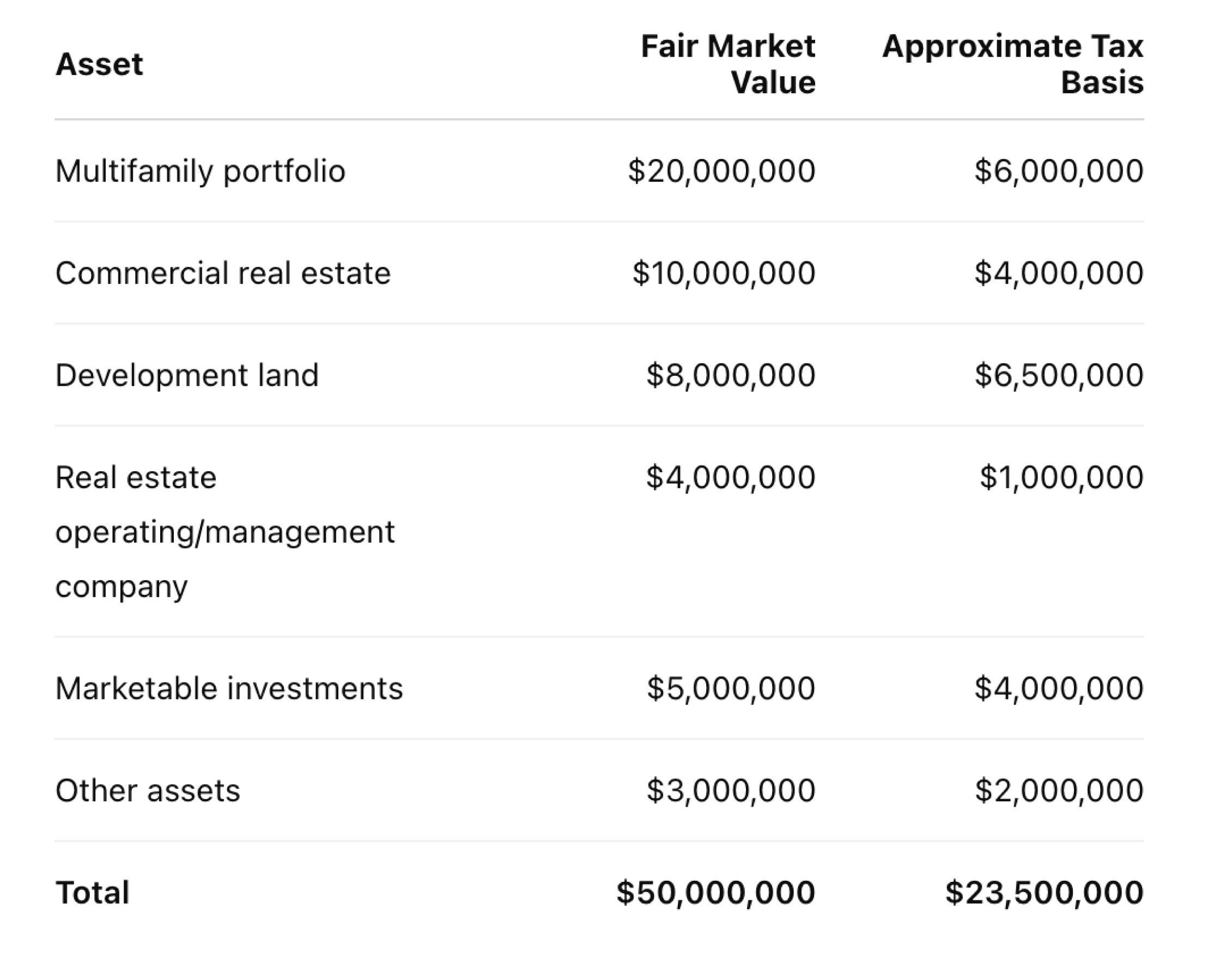
Consider John and Susan, both age 62. Over the past thirty-five years, they have built a substantial real estate portfolio. John remains actively involved in acquisitions and development, although their oldest daughter, Emily, increasingly manages the family business. Their other two children, James and Caroline, have careers outside the family enterprise.
Their balance sheet looks approximately as follows:
The family faces several competing objectives.
John and Susan want to reduce the amount of wealth potentially subject to estate tax. At the same time, they do not want to surrender control of the real estate business prematurely. They want Emily to eventually manage the portfolio but want all three children to participate meaningfully in the family's wealth.
They also recognize that much of their existing real estate has appreciated substantially and carries a relatively low income-tax basis.
Finally, the family's development land presents a significant opportunity. Although currently worth approximately $8 million, several parcels are expected to be entitled and developed over the next decade. If successful, the underlying equity could ultimately be worth several times its present value.
The question is therefore not simply how to transfer $50 million.
The more important question is:
How should the family position today's assets so that tomorrow's appreciation occurs in the right place?
Step One: Reorganizing the Family Enterprise
The first stage of the plan may have little to do with estate tax.
John and Susan first review the ownership structure of their portfolio.
Rather than allowing each child eventually to inherit fractional interests in numerous properties, the family restructures appropriate holdings into a coordinated entity structure.
A simplified version might look like this:
John & Susan / Family Trusts
↓
Family Real Estate Holdings LLC
↓
Multifamily Holding LLC
Commercial Holding LLC
Development Holdings LLC
Management Company
Individual property-level LLCs remain underneath the appropriate holding entities where necessary for liability, financing, tax, or operational purposes.
The family holding company creates two classes of ownership interests:
Voting interests carry managerial and governance rights.
Nonvoting interests participate economically but possess limited management authority.
John and Susan initially retain voting control.
This distinction gives them something extremely valuable: the ability to begin transferring economic ownership without immediately transferring operational control.
It also creates the foundation for Emily eventually to assume management of the family enterprise without requiring James and Caroline to surrender their economic participation.
XVIII. Choosing Which Assets to Transfer—and Which to Keep
The next step requires analyzing the portfolio asset by asset.
A common mistake would be to assume that John and Susan should simply transfer the assets with the largest current values.
That approach ignores income-tax basis and future appreciation.
The family's stabilized multifamily portfolio illustrates the problem.
The properties are worth approximately $20 million, but their aggregate tax basis is only approximately $6 million. Years of appreciation and depreciation deductions have created a substantial disparity between value and basis.
If John and Susan make lifetime gifts of those interests, the transferred property generally carries its existing basis into the hands of the recipient, subject to applicable rules.
If instead the properties remain includible in their estates and qualify for the basis rules of Internal Revenue Code § 1014, their basis generally would be determined by reference to fair market value at death.
The potential income-tax benefit could be substantial.
The development assets present almost the opposite situation.
The development land is currently worth approximately $8 million and has a basis of approximately $6.5 million. More importantly, John and Susan believe the land could appreciate dramatically as entitlements are obtained and projects are constructed.
That makes the development holdings potentially attractive candidates for lifetime transfer.
The planning principle becomes:
Consider retaining highly appreciated, low-basis assets where basis adjustment may be particularly valuable while transferring assets whose greatest appreciation may still lie ahead.
This is not a universal rule. Estate-tax exposure, state taxes, depreciation, debt, holding periods, anticipated sales, and numerous other factors can change the analysis.
But it demonstrates why sophisticated estate planning requires more than looking at the family's net worth.
XIX. Modeling the Development Property
Assume the family's $8 million development portfolio appreciates to $24 million over the next fifteen years.
For illustration, consider three possible approaches.
Scenario One: Retain the Property
John and Susan retain the development interests.
Current value: $8 million
Future hypothetical value: $24 million
Future appreciation: $16 million
The principal advantage is straightforward: John and Susan retain complete ownership and control. If they hold the property until death and the interests qualify for basis adjustment under § 1014, the family may also receive a substantial income-tax basis benefit.
The disadvantage is equally apparent.
The entire $24 million value may remain within John and Susan's taxable estates, subject to whatever exclusions, deductions, and estate-tax rules apply at that time.
The family has allowed $16 million of post-planning appreciation to accumulate in the senior generation's estate.
Scenario Two: Make a Lifetime Gift
Suppose John and Susan instead transfer some or all of the development interests to appropriately structured trusts for descendants while the property is worth $8 million.
The transfer uses available gift and potentially GST exemption based upon the value of the interests transferred.
If the interests subsequently appreciate to $24 million and the structure operates as intended, that post-transfer appreciation may occur outside John and Susan's taxable estates.
Economically, the family has potentially moved $16 million of future appreciation without making an additional $16 million transfer.
The tradeoff is basis.
The gifted assets generally do not receive the same basis adjustment that assets retained until death potentially receive.
The family therefore must compare the potential estate-tax savings against the future income-tax cost associated with the transferred basis.
Scenario Three: Sell the Interests to a Grantor Trust
A third alternative may be to transfer the development interests through a sale to an irrevocable grantor trust.
For simplified illustration, assume interests valued at $8 million are sold to a properly structured trust in exchange for an $8 million promissory note after the trust has been appropriately established and capitalized.
The transaction effectively replaces the appreciating real estate interest in John and Susan's estate with a fixed-value note.
If the transferred interests eventually grow from $8 million to $24 million while the note remains subject to its contractual repayment terms, the appreciation above the economic cost of the transaction can potentially accrue for the trust beneficiaries.
The family has attempted to freeze the senior generation's value while transferring the growth.
The strategy may become even more powerful if John or Susan is treated as the owner of the trust for income-tax purposes. The grantor may remain responsible for income taxes attributable to trust income, allowing trust assets potentially to compound without being reduced by those income-tax payments.
For a cash-flowing real estate enterprise, distributions associated with the transferred interests may also provide a source for satisfying the trust's note obligations.
There is likely no single "best" strategy. The estate-tax result may favor one structure. The income-tax result may favor another. Control considerations may favor a third. Sophisticated planning attempts to optimize all three.
XX. Adding a SLAT to Preserve Family Access
John and Susan are comfortable transferring substantial wealth but remain concerned about giving away too much too early.
One potential solution is a Spousal Lifetime Access Trust.
For example, John could establish an irrevocable trust for Susan and their descendants and transfer selected nonvoting interests in the family real estate enterprise to the trust.
If properly structured, those assets and their future appreciation may be outside John's taxable estate.
Susan, however, could remain an eligible beneficiary of the trust.
This creates an important economic distinction between an outright gift to children and a transfer to a SLAT.
The family has moved wealth into a long-term trust structure while retaining a potential avenue through which Susan can benefit from trust property.
The family must nevertheless recognize that this access is indirect and conditional. Divorce or Susan's death could eliminate John's indirect access, and reciprocal-trust concerns require careful planning if Susan establishes a similar trust for John.
The SLAT should therefore be viewed as an estate-planning structure—not simply a savings account that the family expects to continue using as before.
XXI. Managing the Basis Problem Over Time
Assume fifteen years pass.
The planning has worked exceptionally well.
The development interests transferred to an irrevocable grantor trust have appreciated dramatically. But those interests now contain significant unrealized gain.
Meanwhile, John and Susan hold cash, marketable securities, or other assets with relatively high basis.
If the trust agreement and applicable law permit, the family may evaluate whether the grantor can substitute assets of equivalent value.
For example, John might transfer $10 million of cash or high-basis assets to the trust in exchange for $10 million of low-basis real estate interests.
The economic value of the trust remains the same.
But the low-basis property is now back in John's hands.
If John later dies owning the interests and they qualify for basis adjustment under § 1014, the family may potentially obtain a new income-tax basis while the substituted high-basis assets remain in the trust.
This is why advanced estate planning cannot be treated as a transaction completed fifteen years earlier.
The plan must be actively managed.
XXII. Solving the Three-Child Problem
Tax planning addresses only half of John and Susan's challenge.
The other half is succession.
Emily has spent years helping build and operate the portfolio. James and Caroline have not.
John and Susan want all three children to benefit from the family's success, but they recognize that dividing every ownership interest equally could create conflict.
Suppose each child receives exactly one-third of the voting and economic interests.
Emily wants to retain cash to acquire another apartment project.
James wants larger distributions.
Caroline wants to sell several properties and diversify the family's wealth.
None is necessarily wrong.
They simply have different objectives.
John and Susan therefore separate economic participation from managerial authority.
Emily eventually receives or controls the voting interests necessary to operate the real estate enterprise, subject to appropriate fiduciary and governance restrictions.
Long-term trusts for all three children hold substantial nonvoting economic interests.
James and Caroline therefore participate in the financial success of the portfolio without possessing unilateral authority to interfere with ordinary management.
Major transactions—such as selling substantially all of the portfolio, taking on extraordinary leverage, or entering related-party transactions—may require additional approvals under the governing documents.
The family might also create a board that includes Emily, other family representatives, and one or more independent members.
The result is neither equal control nor exclusion.
It is a governance structure designed around the family's actual circumstances.
XXIII. Creating Liquidity Outside the Real Estate Portfolio
John and Susan also recognize that virtually all of their wealth cannot remain tied to real estate.
Their plan therefore maintains a separate liquidity strategy.
Marketable investments provide one source.
Life insurance may provide another.
Depending upon the family's objectives, insurance owned through an appropriately structured trust could provide cash following death without requiring the family to immediately sell or refinance real estate.
Liquidity can serve several purposes:
paying taxes and administration expenses;
satisfying debt or guarantees;
funding property-level obligations;
providing working capital during the management transition;
equalizing inheritances among children; and
preventing distressed sales.
Suppose Emily ultimately receives greater economic ownership in the real estate enterprise because of her decades of involvement.
Insurance or liquid investments could provide additional assets for James and Caroline.
This allows John and Susan to pursue equitable treatment without requiring identical asset distributions.
XXIV. The Family Before and After Planning
Before planning, the family's structure is relatively simple:
JOHN & SUSAN
↓
$20M Multifamily
$10M Commercial
$8M Development Assets
$4M Management/Development Company
$5M Investments
$3M Other Assets
Total Family Wealth: $50 Million
Most of the assets remain directly or indirectly associated with John and Susan's taxable estates. Future appreciation continues accumulating there. Management succession is largely informal.
After implementing a coordinated plan, the structure could look substantially different:
JOHN & SUSAN
→ Voting/Managerial Interests
→ Selected Low-Basis Real Estate
→ Liquid Investments
→ Residence and Personal Assets
IRREVOCABLE FAMILY / DYNASTY TRUSTS
→ Nonvoting Family Holding Company Interests
→ Long-Term Family Investments
→ Assets Intended for Children and Future Generations
SLAT
→ Selected Nonvoting Real Estate Interests
→ Potential Benefit for Spouse and Descendants
GRANTOR TRUST
→ High-Growth Development Interests
→ Future Appreciation Above Transaction Economics
FAMILY REAL ESTATE HOLDING COMPANY
→ Multifamily Entities
→ Commercial Entities
→ Development Entities
→ Management Company
The family has not simply divided a $50 million estate.
It has begun dividing the economic characteristics of that estate.
Control remains where it is needed.
Future appreciation is intentionally shifted toward younger generations.
Low-basis assets are evaluated for potential basis planning.
Liquidity is maintained separately.
Economic ownership can benefit all three children.
Management authority can transition to the child actually operating the business.
And long-term trusts provide a mechanism for extending the structure to grandchildren and later generations.
XXV. What the Case Study Demonstrates
The hypothetical $50 million family illustrates a broader point about estate planning for substantial real estate families.
The planning question should rarely be: What trust should we create?
The better questions are:
Which assets are likely to appreciate the most?
Which assets have the lowest basis?
Which assets should remain within the taxable estate?
Which assets should begin moving to the next generation today?
Who should receive the economic benefits of ownership?
Who should control the portfolio?
How will the family satisfy liquidity needs without selling core properties?
What happens when the founder is no longer capable of making the decisions?
And what structure gives the third generation a realistic opportunity to preserve what the first generation created?
The answers may involve LLCs, long-term trusts, SLATs, GRATs, grantor-trust sales, life insurance, valuation planning, basis management, and governance agreements.
But those are tools rather than the objective.
The objective is to create a structure in which tax planning, real estate ownership, family governance, and succession work together.
For a family with $50 million—or $500 million—of real estate, that distinction can determine whether the portfolio is merely inherited or becomes a true multigenerational enterprise.
About Peck Baxter
Peck Baxter advises individuals, families, family offices, business owners, and real estate investors on sophisticated estate planning, business succession, real estate, and corporate matters.
Our approach recognizes that substantial estates frequently cannot be addressed through estate-planning documents alone. Effective planning requires coordination among trusts and estates, tax strategy, entity governance, real estate ownership, financing, business succession, and long-term family objectives.
For families whose wealth is concentrated in real estate and closely held businesses, Peck Baxter works with clients and their other professional advisers to develop structures designed to preserve assets, facilitate generational transitions, and support the continued operation and growth of family enterprises.
Important Notice
This publication is provided for general informational purposes only and does not constitute legal, tax, accounting, or investment advice. The application of the strategies discussed above depends upon individual circumstances, applicable federal and state law, asset values, tax basis, entity structures, and other considerations. Individuals should consult appropriate legal, tax, accounting, valuation, and financial professionals before implementing any estate-planning strategy.